Pages

Welcome

You have found us. We are a secret group of crack birders who have turned our backs on the machismo, corruption, and backstabbing greed that constitute today's birding scene, and have united together to follow the True Path of non-competitive, collaborative and generally lovely birding-as-meditation-and-spiritual-growth. Consequently, we never see anything. Birds that land right in front of our noses, and which we can identify with our observer book, are written about here. Oh, and they have to be seen in - or from - the parish of Winterton-on-Sea, Norfolk, or on the walk round past East Somerton Church ruins and up the concrete track to Winterton Holmes (because it's a nice walk which we all do).

Sunday, 6 March 2022

February 2022 Roundup

 February began with a small flock of around 15 Snow Buntings still on the beach, and Pat had some excitement as a Tawny Owl visited his newly cleaned out nestbox. Fingers crossed... The inland farmland contained small numbers of waders in the flooded patches - Lapwing, Snipe, Dunlin and the reliable Green Sandpiper. Several large flocks of Golden Plover were seen and the occasional small party of White-fronted Geese could also be found amongst the Pinks


The family of three Cranes was also quite reliable in the fields to the west of the concrete track, and Kingfisher was seen regularly through the month on various dykes.

On the 2nd Sean saw the Lesser Whitethroat again in the same area as in January, and on the 3rd Mick saw three Whooper Swans going north and a Brambling in the mixed Chaffinch and Reed Bunting flock feeding in one of the maize patches. Maize will not be planted on the estate  next year as it's stopping shooting, so we are not sure if we'll get similar flocks again. A bit later on Mick and Tim were treated to the fantastic sight (and sound) of a flock of 35 Bewick's Swans, and at least one Whooper, flying south towards the village. 

Sean had a Lesser Black-backed Gull on the Commissioner's field and the Little Grebe put in another appearance on the dyke.

On the 4th Sean found a Redshank in the flooded field, and then spent a long time going very carefully through an extremely large flock of Pink-footed Geese which had, for once this winter, settled at a reasonable distance. Sadly no Bean Geese were mixed in with them, at least as far as he could see. 

On the 5th Pat found 3 Bewick's Swans sitting in the Commissioner’s field (which provided a welcome grip-back opportunity for those of us unlucky enough to miss the big flock).  


On the 6th Pat had a Great-northern Diver on an otherwise unproductive seawatch. Later he and Mick saw a maximum of 6 Gadwall on the flooded field, as well as 11 Ringed Plover. Maynard had a productive walk around on the same day, seeing a Brent Goose, and a first winter Iceland Gull on the beach near the fishing sheds. Pat heard a Bullfinch along Low Road. 

On the 7th Sean took this stunning photo of a male Hen Harrier sitting in a field from Bramble Gap.  Please put a cross to indicate your guess and send it in for a chance to win the big prize jackpot 😂.

On the 8th a female Hen Harrier was hunting near the flooded field, over 7 White-fronted Geese


Anyone like to guess what this sound is?  


Click HERE to listen to it.

It's a species which has sadly remained absent from all our patch yearlists until the 9th February 2022...  That morning Sean was at Bramble Gap scanning the extremely distant geese. Despite the huge distance there was no heat haze and the light was excellent. Suddenly, even further back, he thought he saw a Bittern land in a reedbed, far off on the other side of the Horsey Road. He couldn't entirely rule out something like a Short-eared Owl though so continued scanning. His messages to the group show what happened over the next 10 minutes. 


Considering the extreme distance, Sean's second and third views were excellent; he could see the neck, the lighter brown wing coverts etc, and was elated! Although it was not actually ON the patch, our rules allow birds seen FROM the patch too, so it was a full patch life tick!  However, it was not in fact the first Bittern Sean has recorded here.  The above sound recording is of a Bittern which flew around his garden calling every thirty seconds or so, for about three minutes on the night of 24 April 2020, just after 9pm.  But unless we actually hear a bird with our own ears, our rules forbid us from adding such recordings to our own patch lists.  For completeness, there is another fairly recent sight record of Bittern here, seen by our ex-neighbour Ryan, who had one fly over the south dunes and out to sea a few years back.

On the 10th Mick saw three Red Kites drifting south from Bramble Gap, and Sean and Colin picked therm up on the edge of the village. 


Sean also heard a Curlew flying high over the North Dunes that morning but annoyingly couldn't see it (which doesn't matter for the year list though!).  Later that evening 2 Tawny Owls calling and showing in the Duffle's Pond/paddocks area were Sean's 100th species for 2022 - the 10th February is a new record for the yearlist 'ton', 8 days earlier than Maynard's last year.

On the 12th Tim photographed this excellent male Sparrowhawk in his garden. 

On the 13th Maynard saw the Little Grebe again and shot this nice video of the obliging Green Sandpiper on the flooded field. 


On the 16th Chris, our regular visiting birder from Bedfordshire, saw a Peregrine from Bramble Gap, and on the 18th he saw a Shag in a brave short seawatch during Storm Eunice. A few days later he had a singing Treecreeper at the ruined church.  On the 21st Sean had a flock of 12 Knot and 2 Grey Plovers going north, and there were many Kittiwakes moving south.  On the 22nd Barry counted 40 Snow Buntings on the north beach. 

Dunlin numbers in the flooded field began to climb towards the end of the month, with Mick recording 14 on the 24th and Sean counting 30 on the 27th. 

Pat had a Tundra Bean Goose fly north on the 26th, and Barry had a Long-eared Owl in the south dunes.

On the 27th a message from Tim A, our neighbour to the north in Sea Palling, alerted us to a Raven heading south, and Sean was lucky enough to get on to it half an hour later as it came through the dunes then headed out to the beach.  Thanks Tim!


Interestingly a Raven was also recorded at Caister, to the south of us, some three hours later, so if it was the same one it must have stopped off for a rest somewhere!

On the 27th Mick saw this pair of Eider float north.  A female has been around for most of the winter so perhaps it's been joined by the male.

Colin had a Peregrine hunting again at Commissioner's on the same day, and Meadow Pipit numbers began to build around this time too, with Sean counting 50+ that evening in the North Dunes.

On the 30th the Dunlin numbers on the flooded field started to subside, with 27 recorded (down from 30 the day before).  There were also a pair of Gadwall on Commissioner's Dyke that morning and a couple of small flocks of Siskins appeared to be on the move, with 5 going south at the concrete blocks and a few more heard from Bramble Gap. 

At the end of February we have collectively recorded 117 species on the patch, and are looking forward to spring migration getting underway in earnest next month.  Already birds are on the move - the geese numbers are declining as they head off, more Ringed Plover and Lesser Black-backed Gulls are around, and winter thrushes are starting to appear in little flocks as they prepare for their own incredible journeys.  

Happy patch birding everyone!

Saturday, 5 February 2022

January 2022 Roundup

This post is guaranteed to contain no Short-eared Owl photos. Honestly, how many Short-eared Owl photos does the world need?  Due to the presence of our wonderful avian celebrity visitors, the dunes in January have been absolutely swamped with photographers throughout the month. Many were also birders, therefore aware of issues of disturbance and field craft, who kept to the footpaths and were careful not to flush the owls, but many more were members of the non-birding long-lens-no-bins brigade, and sadly a not insignificant proportion of these, who seemed to want to get their shot at any cost, consistently hounded the birds, chasing after them when they saw them land, trampling through the heather and marram and putting them up again for yet another action shot. Our birds here have enough problems with off-lead and often out of control dogs racing across every inch of what is supposed to be a National Nature Reserve and Site of Special Scientific Interest, without humans who supposedly profess an interest in the natural world adding to their woes.  Rant over; I will now get on with what else we saw in January!

The month began with Pat out first and finding the ringtail Hen Harrier hunting for over an hour in the fields around the concrete track, and Mick confirming that the Tree Sparrow was still around - a crucial year tick for us all on day one!


The concrete track area also held 3 Cranes (two adults and a young bird who were to remain in the same general area for most of the rest of the month), a showy Great White Egret and seven Whooper Swans flying south east mid-afternoon.  A few Fieldfares were also around and two Mistle Thrushes in the field at the end of Low Road were a relief for Sean, who one year recently had to wait until December to get them on his patch year list!

On the morning of the 2nd Barry found a Shag on one of the groynes.  Several of us went up for it a bit later and relocated it a few groynes down, looking distinctly unwell.  It perked up a bit in the sun but later tucked itself further in to the crevices between the rocks, where it swayed unsteadily.  By the afternoon it could not be found.

On the 3rd Sean found a pair of Bullfinches in a hedge along Low Road, always a tricky bird for the yearlist, and Maynard a Siskin in the valley.  

On the 4th Mick had two Purple Sandpipers on one of the north beach groynes, and on the 5th he had 5 Fieldfares in off and 2 Ringed Plovers on the beach. They tend to disappear from the beach over the winter so it is always a pleasure to see them in January.

On the 6th Pat relocated one of Sean's Bullfinches in the same place, and snapped a record shot. 

A fishing Little Egret had replaced the Great White in Commissioner's Dyke, and the ringtail Hen Harrier, a Kingfisher and several Song Thrushes were about on the inland part of the patch. Colin had a Gadwall in the dyke, the only one of the month. 

On the 7th Colin noticed that both species of Egret had come to a truce and decided to share the Dyke, Tim had a male Merlin in the paddocks and Barry found two male Bullfinches in a different location along the concrete track. A bit later Barry also found this splendid Black Redstart which had taken up residence amongst the debris below the cliff at the bottom of Beach Road which had tumbled over during the recent high tides.  We often seem to get a Black Redstart on or near the beach in early January! There was also a female Eider off the south beach. 

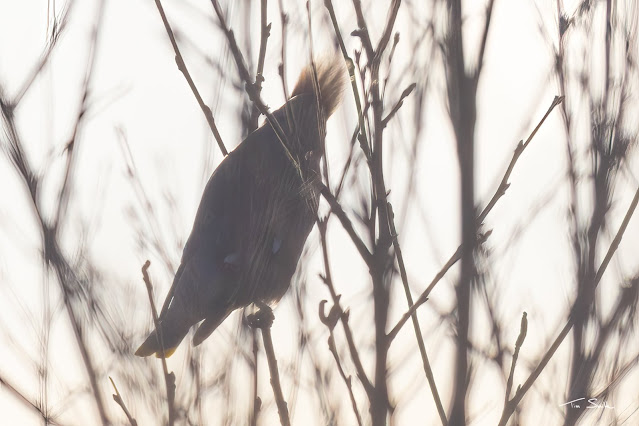
Also on the 7th a visiting birder, Tim S, had a 20 second encounter with a Waxwing in the North Dunes, which flew west over him (presumably having just arrived off the sea), hovered once over the heather, and then shot off towards the woods.  Despite how brief the encounter was, Tim managed to capture this record shot. 

Another of our regular visitor Chris came up from Bedfordshire on the 8th and as well as the Black Redstart which had remained overnight he saw a Purple Sandpiper on the tank traps below the car park. Clearly the Sandpiper found a good source of food here as it could be seen there daily at the right tide time for the rest of the month. 

As the seals moved off the beach after their breeding season it became possible to walk north again, and the level of pup mortality seemed extremely high this year. Between the car park and Bullet Hill there must have been almost a hundred little white corpses. The awful storms had surely done considerable damage to the colony this year.  Looking on the bright side though, we had high hopes of attracting some nice white wingers to this veritable gull cafe.  

We also had high hopes of another white winger. In nearby Martham around this time several Cattle Egrets had turned up. This is a species we have never seen in Winterton but the pundits amongst us have widely predicted to be the next addition to our list. However we've recently lost our only cattle herd, and it wasn't to be, despite them hanging around just a couple of miles away for ages!

On the 12th Sean and Colin saw a Green Sandpiper flying around, presumably disturbed by the shoot.  We have heard that this is the last year of shooting on the Burnley Hall estate, and boy are they making the most of it!  On almost every day in January hoorays have been blasting birds from the sky.  It's certainly made seeing Woodcocks a doddle this month! After one particular volley of gunshots a Buzzard stumbled through the sky, emerging from of the woods with most of its primaries missing from one wing.  I'm not absolutely certain that it was toff damage but circumstantial evidence is strong...

On the 13th Sean and Tim saw the first Little Grebe on the patch for two years!  Pat saw the first Treecreeper of the year along the concrete track, as well as the Bullfinches that Barry had found a week earlier. He also heard a Water Rail along the Holmes Road - a very tricky year tick since we don't allow nocmig recordings (a rule that really ought to be reviewed I feel 😂). 

Several Barn Owls were being seen on the patch around this time too, often hunting in daylight and providing alternative owl photography options for some...

On the 16th Pat had a very large Peregrine from the concrete track, the only one of the month. Snipe and Green Woodpecker were also added by others to the collective yearlist.

On the 17th Sean found 5 Russian White-fronted Geese in with the Pink-footed Geese at Bramble Gap, which were seen again over the next few days.  

On the 19th Barry saw 15 Snow Buntings on north beach.  They had disappeared for a few weeks so it was good to see them back, including a few nice males.  Ted took this nice photo of one later in the month.

Later that day Sean saw a single female Common Scoter off the south beach, and was lucky enough to see this Iceland Gull as it cruised south, ignoring all the nice seal meat below it. Kittiwakes were also passing in small numbers.


On the morning of the 21st  there was a Treecreeper again near the old Poplar wood, an adult Lesser Black-backed Gull at the Commissioner's pool, and another Treecreeper along Holmes Road, accompanying the tit flock along with this Chiffchaff.

Much more surprisingly, Sean found an entirely out of season Lesser Whitethroat along the Holmes Road. 

On the 23rd Pat found two Dunlin on the Commisioner's pool, and a nice Green Sandpiper which unusually hung around out in the open for the rest of the month, rather than hide itself in a ditch.

On the 24th Tim found at least 15 Redwings in one of the paddocks, the largest group of the month, and Sean had the month's second Black Redstart on the northern edge of the village. 

On the afternoon of the 25th Mick saw a Merlin hunting along the edge of the East Somerton fields.

The next morning on the 26th Sean was lucky enough to complete the white-winger double with views of a Glaucous Gull flying north through the dunes. One had been reported the previous day at Waxham so it might possibly have been the same bird. Once more it seemed uninterested in the buffet on the beach.


On the 27th Tim had two Russian White-fronted Geese from the concrete track.

Over the next few days Dunlin numbers in the flooded field began to increase, and on the 29th Colin saw the Merlin in the same area that Mick had seen it in. That afternoon Pat was very lucky to flush a Jack Snipe up from right on a busy main path in the North Dunes. Meanwhile in a short seawatch Barry had a Mediterranean Gull, two Fulmars and 16 Lapwings in off. 

On the 30th Maynard reported a Tundra Bean Goose from the concrete track when he had returned from his morning cycle ride. Unfortunately it was not around when the rest of us went to look. Maynard also had a Grey Plover that day, the only one seen during January. 

The month ended with a strong northwesterly gale and we had hopes that the sea might be interesting, but a long seawatch produced only Kittiwakes, Gannets and three Wigeon for Sean.

At the end of January we have collectively seen 108 species on the patch. Sean is some way ahead in the year list race - he saw 94 species in January, which smashed his previous best, and clearly demonstrates the benefits of being retired (or a 'leach on society' as his youngest son put it) for building your local patch year list.  

Happy #localbigyear patch birding everyone. 

Thursday, 6 January 2022

December 2021 Roundup

A very short roundup this time folks. The month started with a bit of a cold snap.  A short seawatch on the 1st produced a Velvet Scoter sitting on the sea, a couple of Eiders past and a Woodcock in off.  The rough weather and high tides eroded quite a lot of the dune ridge along the car park and off the sheds - it's getting more and more difficult to settle for a decent seawatch as our favoured places are disappearing...

On the 2nd Colin had a Short-eared Owl in the North Dunes and 3 Cranes from the Concrete Track, whilst a short afternoon seawatch for Sean produced 1 male Goldeneye north, 2 Bonxies south, a male Goosander in off heading presumably towards the Broads, 1 Brent Goose north, a Velvet Scoter, plus a few Eider and Common Scoter

On the 3rd Colin saw another, or the same Short-eared Owl in North Dunes, and on the 5th he had the three Cranes again in the same place, and a Woodcock heading fast inland through the North Dunes, presumably freshly arrived. 

On the 6th Sean saw a ringtail Hen Harrier hunting for quite a while near the inland end of Low Road, and on the 8th he had two juv Little Gulls close in along the surf off the north beach.  Colin continued his Short-eared Owl observations again on the the 9th.  

Probably the most exciting avian event of the month happened on the 15th when Barry found a Tree Sparrow in the valley, associating with the resident House Sparrow flock.  A full-on twitch ensued for those able to get there (ie the retired contingent since it was a weekday), including a dash back from Buckenham for Sean where he had been on a rare trip away from the patch looking for the Taiga Beans - fate was clearly telling him to avoid this sort of irresponsible frippery in the future! 

Luckily for those of us who are less of a burden to society and still paying National Insurance contributions, the dinky spadger hung around until the end of the month, allowing most of us to catch up with it in the end.  However it proved a tricky blighter to get a decent photo of; Pat probably managed the best ones a couple of weeks later:


Not much more birding got done over the festive period until the month's end. On the 21st Tim had a two Mistle Thrushes from Low Road, and on the 27th Pat had 3 Cranes, 25 Dunlin and several Snipe in the flooded field near Commissioner's Dyke, plus a very distant wader which he initially thought was a Redshank but could have been a Ruff. Graham paid a visit and saw 4 Short-eared Owls in the North Dunes. There seemed to be some movement on the sea too, and in the morning Pat had a fair few ducks moving: Pintails, Wigeon and Teal, plus some waders too: 4 Grey Plover, 4 Redshank, a Purple Sandpiper and a Dunlin.  The top waders of the day were in the afternoon though, when Sean had the amazing sight through his scope of 5 Avocets flying south just offshore (plus a Woodcock in off). 

Short-eared Owls and the occasional Woodcock continued to be seen occasionally as the year drew to a close, and on the last day Sean confirmed the continuing presence of the Tree Sparrow in the valley, in readiness for the new year lists the next day...

So that was 2021.  Mick saw the most species - 181 - which in the end was one more than Sean who decided to remove his heard-only Bearded Tit record since he didn't want to have it on his patch life-list without seeing it as well. 

In total we collectively saw 204 species in 2021. That's a good number, and we saw some great birds. We thought about doing a summary of all the best ones here, but you can read about them in the other posts, and it is a sad but true fact that for many of us 2021 will be, and probably should be, remembered more for the incredible lack of supposedly 'common' autumn migrants like Goldcrests and the hastening disappearance of previously regular birds like Marsh Tit (which only a lucky couple of us managed to connect with).  

Yes we had some wonderful scarce and rare birds over the year, as ever. But patch birding here, day in day out, is about much more than the rare species; it is about noticing the seasonal comings and goings and ups and downs and successes and failures of all the birds - and all the other species of life - that we are lucky enough to have around us.  And it wasn't all doom and gloom - the Little Terns did well for example, and Linnets seem to have had another good year, and Pete refound a rare liverwort...  We fervently hope that this time next year we can be writing some more good news: come on you Goldcrests

Happy New Year to all and happy patch birding in 2022 #LocalBigYear. 

Wednesday, 8 December 2021

November 2021 Roundup

November was generally an unexceptional month as the Autumn migration petered out.  On the 1st seawatching was slow, with the odd Arctic Skua and Great Skua, and several Kestrels in off, including one which was tracked arriving from about two miles out. The journey took about 20 minutes and the plucky little falcon was almost caught by several Great Black-backed Gulls before making it to land.  

Several Rock Pipits remained around on the north beach, and Short-eared Owls were much in evidence on the North Dunes.  A few Fieldfares were beginning to arrive, with 2 in the North Dunes on the 2nd, plus a Bullfinch calling along the Holmes Road. Snow Bunting numbers built up a little, with 26 counted on the beach on the same date.

On the 3rd a Barn Owl was hunting in the North Dunes well into late morning. Also around were a singing Chiffchaff in the Birdless Bushes, a couple of Goldcrests and Coal Tits, and a Treecreeper in the Holmes Road.  There was also a tern feeding off the sandbar, initially found by visiting birder Stephen H, which we eventually pinned down as a rather late Arctic Tern.

On the 4th seawatching produced big numbers of Eider - over 200 on the final count, plus several BonxiesGoldeneye, 2 Velvet Scoter, a Goosander and a range of more common ducks. Little Gulls and Golden Plover were also seen.

On the 5th a Little Auk went north quite early on, and an eared owl, probably a Short-eared Owl, came in off rather distantly.  This was followed by several more definite Short-eared Owls coming in at various times and locations through the morning.  Despite plenty of Long-eareds being seen arriving in North Norfolk, ours were all Short-eareds.  There had also been a slight arrival of warblers, with a Chiffchaff in Pete's garden and another one later in Colin's, a Willow Warbler below the lighthouse, and a very brief Yellow-browed Warbler seen with a small tit flock by Barry in private gardens. It wasn't seen again, although Mick heard it calling later on.  There were also two Black Redstarts in the South Dunes/Hermanus area, and several Bramblings in the high trees at the Hermanus.

On the morning of the 6th,  a few Siskins were moving through the valley, and there was a Brambling below the lighthouse and another (or perhaps the same one) at the Oaks. At least four Short-eared Owls were in the North Dunes, plus a ring-tail Hen Harrier and a Red Kite.

On the 7th there were at least 5 Swallows in the valley, and this slightly interesting Chiffchaff, which had a call somewhere between a normal Chiffchaff and a tristis - a single syllable but rather more optimistic than a siberian chiffy! 

In the early part of the month Ted was honoured by several visits from this wonderful creature to his garden, which had presumably wandered down from its allotment cage.

A few Swallows remained in the valley on the 8th, and there was another interesting, completely brown Chiffchaff with the tit flock along the Holmes Road, plus a Treecreeper. The Chiffchaff didn't call.  At least 30 Siskins were flying around Duffles Pond in the afternoon, and the Short-eared Owl count went up to a possible seven in the North Dunes. 

On the 9th at least 200 Siskins went south through the valley before 9am. 

On the 11th a Great-crested Grebe was sitting close inshore off the South Dunes, and a Woodcock flushed from below the Hermanus in the morning, with another flying over the village in the late afternoon. 

On the 12th a Red Kite flew inland over the north wood, and a Peregrine was making the most of the huge influx of Starlings arriving in off, alongside Fieldfares and Chaffinches. Another Woodcock was flushed off the North Dunes. Another Black Redstart was hanging around on a roof on Old Chapel Road. 

A Purple Sandpiper took up residence on and around the tank traps below the old cafe, and could be seen there at the right tide time for several more weeks. 

Seawatching was slow still, with the odd Bonxie but not much else, although this in-off arrival on the 12th had us going for a while! 

On the 14th and 15th the wind finally blew from the east, coinciding exactly with the dates we had chosen to all do conservation work in the South Dunes, removing Russian vine, so we didn't actually do much birding in the best wind of the autumn, but we did manage a little.  There was another Black Redstart at the Hermanus on the 14th, and early on the 15th Barry had an excellent view of the White-billed Diver doing a close-in flyby (surely THIS will be the final view of this amazing bird).  Later he and Sean had another Little Auk and a Red-breasted Merganser.

On the morning of the 16th Barry had seven Shorelarks on the north beach, but they flew south and couldn't be relocated.  On the 17th Mick had a Merlin near the village and a Woodcock through the valley. 

There was not much more to report as the month moved on.  A ringed Herring Gull on the patch turned out to be at least 7 years old and fairly well-travelled.

This Casp-a-like Herring Gull (or maybe hybrid) was on the north beach for a couple of days too.  It got us looking but its dark underwing, tertial pattern, and lack of a shawl put it firmly in the mudblood camp at best for us - although the structure was promising and the scapular moult was pretty advanced - comments are obviously very welcome from more experienced larophiles!


On the 19th sunshine brought out late butterflies (Red Admiral)and dragonflies (Migrant Hawker and Common Darter), and the first 'Autumn' Blackcap was in Pete's garden. 

On the 20th Tim photographed this nice Sparrowhawk in his garden. 

On the same date Chris, up from Bedfordshire for the weekend, had a Little Auk north in the late morning, as well as several Short-eared Owls in the North Dunes still. Colin also had a Green Woodpecker yaffling away. 

The 22nd arrived with pretty good conditions for seawatching, and began well with a Long-tailed Duck north at 8.23am.   Three Little Auks also went north during the morning, and 2 Great Skuas hunted close in. In the early afternoon these six fantastic Pale-bellied Brent Geese went north - a real rarity here. They were also seen going past Lowestoft 43 minutes earlier. 

In the first hour of the afternoon more birds were moving north, including large flocks of Eider (such as this one with a passenger along for the ride).

Sean was lucky enough to see a brilliant, fairly close juvenile Sabine's Gull at 1.24pm. Interestingly, both Sean (the previous afternoon) and Barry (that morning) had seen what they thought must have been a juvenile Sabine's (seemingly brown upperwing coverts, dark outer primaries) but it had both times been too far out to clinch. This time the bird flew north well inside the Cockle Light, and showed the upperwing pattern very clearly, with the lightish brown coverts particularly obvious and extending forwards, making the bird appear dark-headed.  It seems a very late record. 

On the 23rd things had died down, although there was an immature Little Gull in the surf along the north beach. Pete had another (different) Blackcap in his garden and Sean found an extremely late Willow Warbler in the oak trees along the back of the Hermanus, where it was out of the wind. Getting a good photo was challenging!


The big storm Arwen arrived at the end of the month, producing an unprecedented arrival of Brunnich's Guillemots in the North Sea including one in Norfolk, so we all had high hopes of more decent seawatches but overall it didn't happen, although Barry did have a Puffin fly south on the 27th, along with a couple of Fulmars, Arctic Skuas and Great Skuas. On the 29th a Little Auk flew north in the morning, and there were a few Goldeneye, a Velvet Scoter and several Great Crested Grebes, plus an interesting Skua which two out of three observers thought might well be a Pomarine, but it was too far out to clinch. 

The month petered out on the 30th with a slow seawatch, although a nice male Goosander flew inland and a distant Guillemot sitting on the sea was in full summer plumage, allowing fantasies of it drifting closer and becoming much rarer.  Of course it didn't happen.  At the end of the month we have collectively seen 204 species on the patch.  Happy Christmas, and happy patch birding everyone!