Pages

Welcome

You have found us. We are a secret group of crack birders who have turned our backs on the machismo, corruption, and backstabbing greed that constitute today's birding scene, and have united together to follow the True Path of non-competitive, collaborative and generally lovely birding-as-meditation-and-spiritual-growth. Consequently, we never see anything. Birds that land right in front of our noses, and which we can identify with our observer book, are written about here. Oh, and they have to be seen in - or from - the parish of Winterton-on-Sea, Norfolk, or on the walk round past East Somerton Church ruins and up the concrete track to Winterton Holmes (because it's a nice walk which we all do).

Saturday, 4 September 2021

August 2021 Roundup

First of all an apology and a correction for last month. On 22 July Peter, with huge excitement, informed us all that he had rediscovered a species he has only seen here a very few times since he first found it 15 years ago.  So huge apologies for missing it out to Peter, and here is his original finder's photo of Matt-grass, Nardus stricta, in all its glory, including the subliminal message which suggests Pete may well be a spy for the Chinese government...

The birding action for August began shortly after midnight on the 1st, when Pat popped out into his garden to check on his moth trap and heard a Little Ringed Plover calling as it flew over.

However for much of the month decent birding was in short supply, so for many of us attention turned to other taxa. In early August one particular patch of the dunes was still full of Six Spot Burnet moths. It was strange how concentrated they were in this patch, with few elsewhere. There were thistles in other places but way fewer moths. 

On the dragonfly front several of us saw Lesser Emperors in the North Dunes, and over the course of a few days in early August there were suddenly hundreds of Small Red-eyed Damselflies.  


On the butterfly front various species such as Grayling, Gatekeeper and a few Ringlets were putting on a good show, and there were reports of Purple Hairstreaks around some of the oak stands.  Later in the month Painted Ladies looked rather wonderful feeding on the Sea Holly. Sadly however it really doesn't seem a good year for Dark Green Fritillaries. 

This Essex Skipper in the North Dunes was impressively identified by Murray without him even looking through his binoculars! 

Back to the birds, on the 2nd Tim connected with a Marsh Tit in one of the places we regularly look for but rarely see this increasingly scarce species. I suspect quite a few of us will fail to get it onto our year lists this year, sadly. 

On the 3rd, shortly before their departure, a Swift finally went inside one of the nextboxes on Sean's house, hopefully prospecting for next season, which bodes well if it manages to survive its incredible migration and return to us in May 2022. 

On the 5th there was a steady passage of Swallows through the morning and Mick saw an immature Cuckoo by the North Pool. Pat had a Ruff fly over his garden.  We were still seeing quite a lot of Whimbrel at this stage in the month too.  

Pat's garden skywatching venue continued to produce the goods the next day too, when he had a Green Woodpecker fly over. 

With the birding rather quiet, insect watching remained enjoyable in the South Dunes, with Hornet Hoverflies, Spotted Longhorn Beetles, Giant Tachnid flies and other interesting species around. 


Seawatching started to pick up a little on the 7th, when Barry had 5 Arctic Skuas and 1 Great Skua and Sean had a moulting adult Black Tern fly south.  The next day there was another Black Tern on the beach at dawn, seen by Will the night warden, and later on Lottie, another of the tern wardens, found several more. 


To the tern wardens' concern, the local Hobby family had done well this year principally on a daily diet of young Little Terns, and the adult Hobbies and four young were seen regularly throughout the month. On the 9th Sean saw all six of them chase down and catch a single unfortunate Swift, all working in unison; presumably the adults teaching the young how to hunt in the air. Mick had several Arctic Terns go south on the same day.

On the 10th Murray had a Common Sandpiper on the beach, and another Black Tern was sitting on the beach on the morning of the 11th, when Colin also flushed another Common Sandpiper from the East Pool. That day was a flying ant day, which meant significant numbers of Mediterranean Gulls hawking above the village in the afternoon.

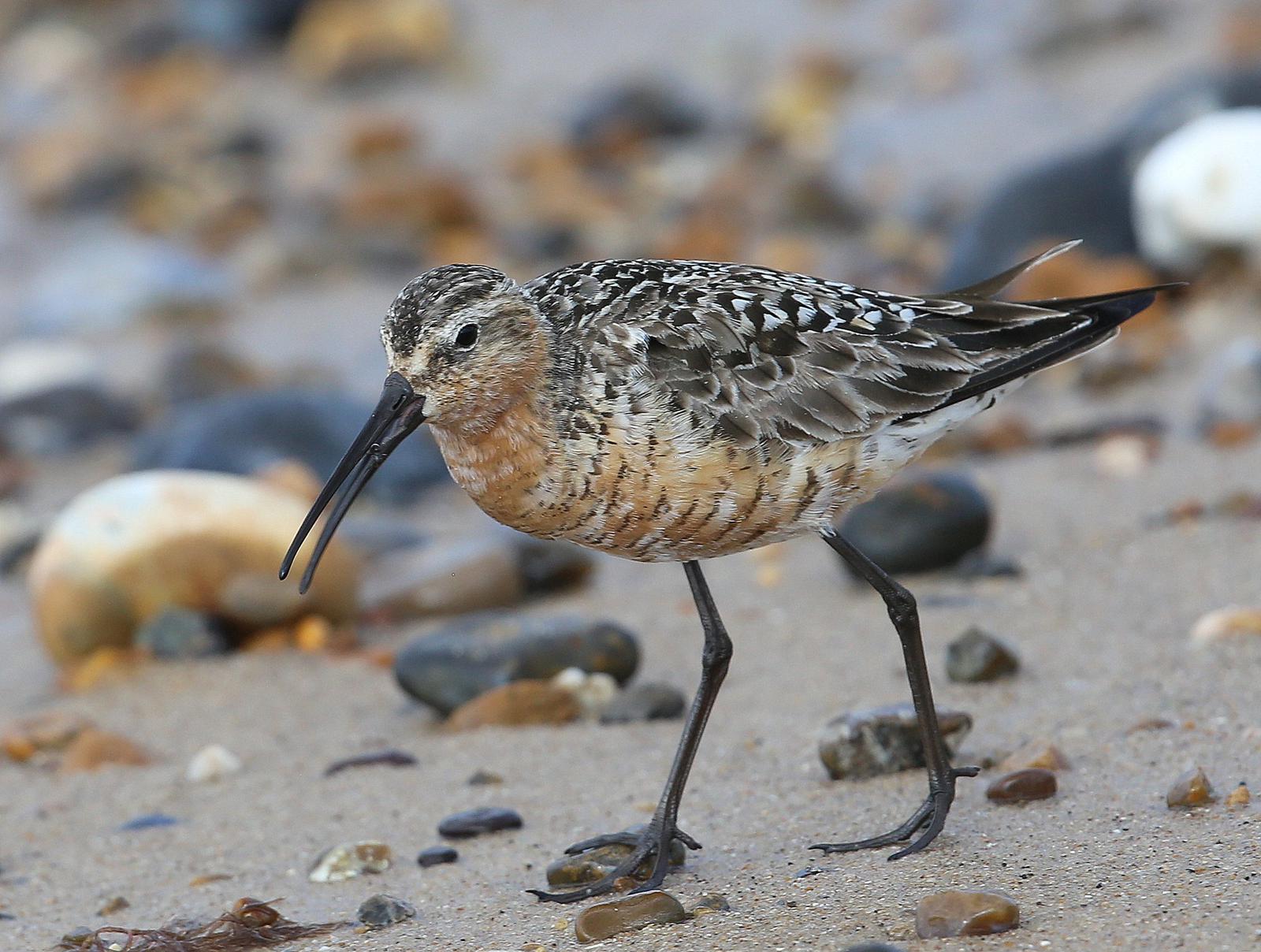
At around 4.30pm on the 11th a visitor asked Mick, who was wardening on the beach, about an unusual wader on the shoreline. On investigation Mick saw that it was a fine Curlew Sandpiper, a species which although very occasionally noted in flight here, has never been seen 'on the deck'.  It was a fantastic bird and we were all super pleased to get a chance to see it.  Lots of photos were taken and here are just a few. 


On the 13th Colin had a Cuckoo in the valley and Sean a Green Woodpecker in the North Dunes, whist in the evening Maynard had a Greenshank on the sand bank, plus another Arctic Skua and several Black Terns. Cuckoo and Green Woodpecker were both noted in the North Dunes on the 14th too, along with 5 Swifts (the majority have now departed). 

Green Woodpeckers continued to give fleeting views (mostly like this one) in the North Dunes until the month's end. 


On the 18th there was a steady passage of Swallows in the morning, all moving north! 

The first returning Wheatears of the autumn were on the 19th, when Barry had two in the South Dunes. 

On the 20th at 5.50am Pete saw a Common Sandpiper feeding in puddles along North Market Road in the village.

Apart from the odd Arctic Skua, seawatching was still uneventful around this time, although the occasional Red-throated Diver was noted, and Fulmars started to be seen, even flying over land up the valley. They seem to do this each autumn: are they looking out for nest sites for next year??

Passerine passage was very slow in mid August although on the  morning of the 22nd the valley held a Garden Warbler and a few more Lesser Whitethroats and Blackcaps, but still no Pied Flycatchers. Where were they?  The local hybrid Hooded Crow took up residence in the car-park/fishing huts area around this time, where it could be found until the end of the month.

In the afternoon of the 22nd Pete flushed a Wryneck in the North Dunes, which proved highly elusive for the rest of us. However whilst looking for it a number of us finally saw the first patch Pied Flycatcher of the autumn, in the clump that the Wryneck had disappeared into. Chris, one of our regular visitors, noted the first Whinchat of the Autumn on the same afternoon.

On the 23rd Murray saw the Whinchat near the East Pool, then later he and Sean had two more near the Birdless Bushes, where there was also a Pied Flycatcher, with another near the concrete blocks. As Sean and Murray walked back towards the village, Sean had a brief but clear view of Pete's Wryneck, which flushed up from exactly the same place as Pete saw it the previous day, and flew over the ridge into exactly the same clump of bushes too. And once again, despite several of us arriving and searching for it, again we couldn't relocate it. Sean and Murray also had a Redstart on their walk back to the village. Tim found another Whinchat near the cable station and also three Wheatears in the North Dunes, whilst later on in the evening Mick had 2 more Redstarts at the Plantation and 2 more Pied Flycatchers in the Totem Pole Bushes. Birds were obviously arriving, albeit slowly.

The excitement was short-lived however, and the next day the dunes were almost totally devoid of birds, although the 2 Redstarts remained at the plantation. And despite the excitement of Graham E's Greenish Warbler appearing tantalisingly close to our patch, the birding for passerines remained very hard going over the next few days. On the 25th 1 Redstart remained at the Plantation, and a single Swift had a flyround to look at Sean's nextboxes. 

There were potentially good seawatching conditions on the 26th, and in the morning the first 2 Sooty Shearwaters of the Autumn were seen by Mick, Tim and Murray, as well as 3 Pintail, 6 Arctic Skuas and a smattering of waders.  On land, Colin had a Whinchat just east of the village.  In the afternoon news came out of a (the) Black-browed Albatross flying east past Sheringham, so Sean, Mick and Barry headed down to the sheds for a just-in-case seawatch.  Several hours later, and with no Albatross seen, things nevertheless brightened up when Barry picked up a small distant skua near the Cockle. He lost it, but seconds later an Arctic Skua appeared a little to the south, so we all assumed it had been that.  However, in another moment there it was again, alongside several Arctics. Significantly smaller, less bulky and with a quite different flight style. Zoom in the Swarovski... and bam! The tail was visible! it was an adult Long-tailed Skua!  I'm extremely wary of claiming LTS at sea and know that Arctics can appear light, tern-like etc, but there was no doubting this one and we were all happy with the ID, Barry even doing a sort of brief Mo Farah dabbing celebration over it (not a sight I'd wish on anyone else). Interestingly, as we watched it move a long way south, it was joined by at least one other structurally very similar skua, but by then they were way too far away to make anything of it.  On the same seawatch were 9 Pintail, 1 Sooty Shearwater, 9 Arctic Skuas, 3 Great Skuas, Kittiwakes and a couple of Guillemots. Not a bad afternoon's work. 

Seawatching produced the only other highlights for the rest of the month too.  On the 27th there were 4 Arctic Skuas, 3 Red-throated Divers, and a Great Crested Grebe, and on the 28th 2 Sooty Shearwater, 2 Manx Shearwaters, 8 Arctic Skuas, 6 Great Skuas, 5 Kittiwakes and good numbers of Gannets

August ended with a couple more Pied Flycatchers and Redstarts, but very little else.  It is a sad truth that we are involved in a hobby which has the capacity to frequently remind us of the ongoing deterioration of our planet's natural resources, and this August, with so few migrants for most of it, was definitely one of those times.  Then on the 29th we learnt with huge sadness that Keith Dye, a stalwart of the local birding scene since forever, had passed away.  RIP Keith, and RIP the many avian migrants that no longer fly in our skies.  

Monday, 2 August 2021

July 2021 Roundup

Birding on the patch in July generally requires a level of dedication which really "sorts the men out from the boys". So since most of us are well into our second childhoods don't expect a lengthy roundup this month!

One exception to our lethargy was Mick who, due to his role as a volunteer tern warden, was out in the field quite a bit more than most of us.  So a lot of the best birds (and insects) this month were down to him spotting them, then alerting the rest of us that it might be worth taking the knotted hankies off our heads, hauling ourselves out of our deckchairs, and struggling along to see his latest find.

This process began on the 1st with a Black Tern on the beach, but at that stage we were all too casual - a party of schoolchildren on an outing scared it off before any of us managed to arrive. 


Pat saw another Black Tern during a brief seawatch on the 6th, along with a couple of Manx Shearwaters, which have been rather thin on the ground so far. 

On the 8th Mick had an Arctic Tern fly past, and Maynard saw two Spoonbills flying from the Concrete Road in the early morning.  There were a couple more Arctic Terns flying around the beach the following evening too, which enabled Sean and Pat to finally connect with them for the year (don't tell anyone, but both of them are too unsure of their tern skills to identify them at anything but very close range 😁). 


On the 10th Mick struck yet again with the best Tern of the lot - a superb adult Roseate Tern on the beach.  This time we didn't have to be told twice and several of us were down there like a shot.  It was a really superb bird and a patch tick for most (all?) of us.  Amazingly, about an hour later it was joined by two more!  Here is a selection of shots of at least two of them. 


Whilst a number of us were enjoying the Roseate Terns, this Arctic Skua did a nice flyby close inshore going south.  


The terns hung around for Pat and Ted to get them later in the afternoon, but all had departed by the evening. 

After all that excitement we needed another rest so attention turned back to our gardens. Pat enjoyed continued views of the Peregrine on and around the church tower from his, and Sean was encouraging Swifts to discover his new triple story nest box in his, and although they were interested they seemed to be having trouble finding the entrance holes, and continually landed on the top of it.  Next year hopefully they'll have figured it out...


Common Scoter began to appear on the sea again in reasonable numbers around the middle of the month, with Barry seeing around 250 on the 13th. The next day Sean saw a similar number, along with a (fairly unusual for July) Red-throated Diver in summer plumage and a male Tufted Duck heading north. 

Returning waders were increasingly in evidence too, with most of us encountering Whimbrel, Curlew, Knot, Dunlin and Bar-tailed Godwits in small numbers on most days. 

On the 15th Mick had another Black Tern feeding offshore distantly, and a Great Skua south.

Back in our gardens mothing was happening, and on the 21st Pat caught this unusual micro called a Dark Bordered Pearl.  It's a migrant with few records in Norfolk until very recently. Amazingly, Pat had another one four days later on the 25th too.  As with many insect species, it seems the heating climate is having an effect on this one's range too. 


Red Kites were also around in July, and on the 22nd Barry had 5 in the north dunes, while Mick had 3 at Commissioners Dyke. On the same day Colin finally caught up with Cuckoo at the Double Pool and Mick had a juv at the Coot Pool too. 

In the North Dunes there's a nice big patch of bushes which we all know as the Birdless Bushes, since their promise has always exceeded what they deliver.  However this year they have been a bit better, with Grasshopper Warbler, Bullfinch and a smattering of other half-decent birds. On the 22nd Sean noted a Willow Warbler in them, and wondered if it was the first returning warbler of the autumn.  As he was looking at it another Willow Warbler began calling, but the more he heard this second bird the more it sounded to him like a Redstart!  Surely this couldn't be the case, and it was another Willow Warbler - the date was just too wrong. The bird was calling low down in the back of the large clump and just would not show.  In desperation Sean recorded the bird on his phone and put it through the notoriously erratic Birdnet app.  Here is the result:


However, despite the app's almost certainty, it would be such an unusual record that one can't go on the app alone (which has got some hilariously wrong nocmig results in the past). The bird never appeared and so we can't rule out a slightly odd Willow Warbler...  Nevertherless, the Birdless Bushes were back in the game!  The following day, in the very same bushes, Barry had a Reed Warbler, Chiffchaff and a pair of copulating Willow Warblers, casting further doubt on the 'Redstart' and also suggesting that far from being a returning migrant Sean's Willow Warbler was more likely to be a late attempting breeder. 

On the 25th Mick was returning from a wardening stint on the beach when he discovered this Lunar Hornet Moth walking across Low Road, so several of us took the opportunity to twitch it and Ted arrived to confirm the ID and take the unfortunate moth into care before releasing it in more suitable habitat at Duffles Pond. 


On the 26th a large flock of Mediterranean Gulls gathered above the village to hawk insects, and around this time of the month a Hobby could be seen above the village each evening trying to outwit the Swifts

On the 28th Barry saw a Green Woodpecker in the North Dunes and later that morning Sean saw one and heard up to three, in widely dispersed locations across the North Dunes.  You wait ages for a year tick then three come along at once!  Was this one bird on the move or some juveniles dispersing?  Views were not good enough to tell.  

Dragonflies were very active at the end of the month, including some rarities such as Lesser Emperor and Small Red-eyed Damselfly, and this Scarce Chaser which Sean saw near the Holmes Road was possibly a first for Winterton.  


Also on the 28th the Birdless Bushes gave even more evidence of their purple patch when Sean flushed an immature Nightjar from their inland edge. 

Again on the insect front towards the end of the month there was a mass emergence of Six-spot Burnets in the North Dunes near the village, as well as good numbers of Gatekeepers and steadily increasing Grayling numbers. 

Two Green Woodpeckers were also seen by Colin and Mick in the North Dunes on the 30th, and Colin also had another Red Kite over the north woods. 

Later on in the afternoon of the 30th, Colin and Gemma both had good views for around five minutes of a bird they are pretty certain was a Black Kite over the North Dunes.  This is very interesting because the day before Sean had had a two second glimpse of a bird over the north wood which he immediately thought was a Black Kite, but it disappeared before he could be certain.  There were no other reports of a Black Kite in the area but Colin is convinced it was one.  On the same day Pat had a Greenshank over his garden, calling, and on the 31st he saw 2 Manx Shearwaters, 2 Arctic Skuas, Redshank, Curlew, Grey Plover, Whimbrel and Turnstone during a morning seawatch in the returning north easterly wind. 

At the end of July the total number of bird species which we have collectively seen stands at 182, and we are eagerly looking forward to see what August will bring.  Pat, on 162, is pulling away in the yearlist non-competition, but several of us remain within striking distance, and it's not over until it's over. Tim always bides his time, and there's the new boy Maynard, who has already shown what he can do...🙂

Happy patch birding everyone. See you next month!

Saturday, 3 July 2021

June 2021 Roundup

Butterflies remained a nice feature in the South Dunes at the start of the month, with Brown Argus and Green Hairstreak continuing to show well, and Painted Ladies, Wall, Holly Blue, Common Blue etc all being seen. 

It wasn't until we started processing our photos that we noticed the snazzy orange headlights of the Green Hairstreak! 


On the evening of the 2nd Sean heard a Grasshopper Warbler reeling in rough grassland and reeds at the north end of the patch, and managed a couple of record shots. 

On the morning of the 3rd another of our regular visiting birders, Drew, found a Marsh Warbler in a small group of willows along the dune ridge at the north end of the patch, and managed to obtain this recording of its song. It was later seen by another of our regular visitors, Mick S, but it had fallen silent or moved on by early afternoon and none of the locals managed to connect with it in time.

In the mid afternoon Barry saw a Rose-coloured Starling fly in from the east through the dunes and go down in the village painfully close to Sean and Peter's gardens. Quite a few of us managed to see it over the next hour or so but Sean was in London being continually gripped off by a stream of delighted WhatsApp messages.  

Things got worse for Sean when later in the afternoon one of the tern wardens, Will B, found a splendid male Red-backed Shrike in the North Dunes very close to the village.  Mick took this picture of it in flight.

By now Sean was driving home from London, trying hard to ignore the continual pings on his phone and not to get done for speeding. He arrived home in the early evening and managed to connect with the Shrike at the end of his road quite quickly.

With no sign of the Starling and not much daylight left Sean decided to cycle up to the north end in the hope that maybe the Marsh Warbler might still be around and might even decide to sing, since the species is known for its nightime repertoire. Amazingly, after only about a 15 minute wait, he was rewarded: it began to sing, initially quite quietly but gathering strength over the next few minutes, in the tangle of brambles and weedy scrub on the west side of the path a little to the north of where Drew had found it. Although he never got a view better than a mainly hidden Acro moving through the weeds, he did manage to record this snatch on his phone. It sang for about 10 minutes fairly continuously, then subsided into the odd short burst, before stopping completely. On his cycle ride back he also heard the Grasshopper Warbler again singing in the same spot as yesterday. 

On the 4th Sean had poor views of another Acro in the South Dunes, but after a little wait it chuntered into song and proved itself to be a Reed Warbler. On the same day Colin had two Canada Geese flying north over the North Dunes, and Sean saw a Red Kite over the north woods. The next day this Barn Owl was hunting in the fields along the concrete track in the early evening. 


After such a terrible start to the year, the Collective moth-ers were getting more success, and Patrick had this very nice Light Brocade on the night of the 5th/6th. 


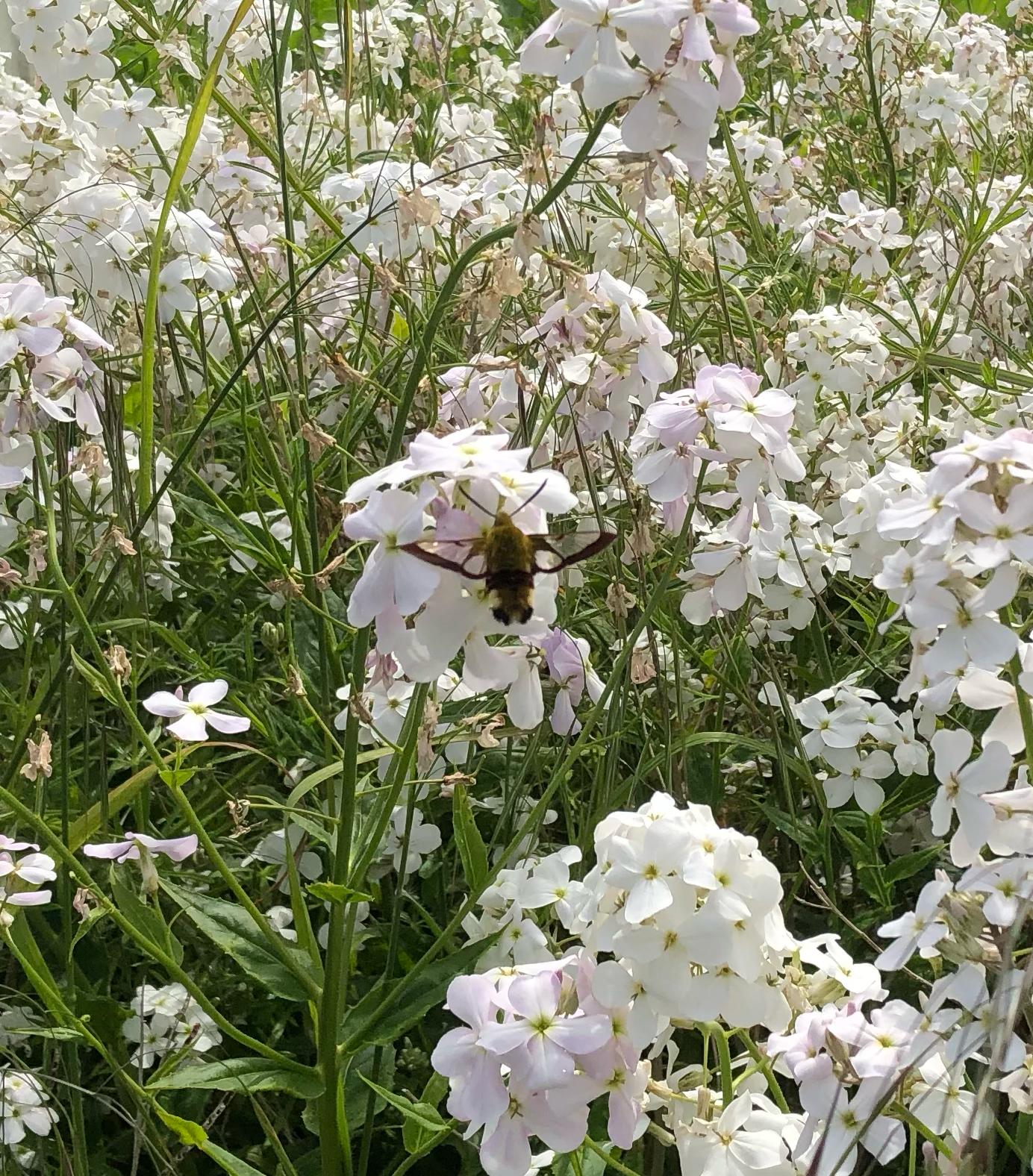
Good diurnal moths also began to put in appearances for Tim, who had this Broad-bordered Bee Hawkmoth on his allotment on the 7th.


Also on the 7th visiting birders found a dark Great Skua on the beach. There was some debate about its plumage and size, and hence identity, but since none of the resident birders saw it we are unable to comment 😁.  On the same day another (or perhaps the same) Rose-coloured Starling was seen in the South Dunes. Sean was yet again away from the village and beginning to despair, but this time there was a happy ending for him!


Here are a couple of nicer record shots of the bird from Patrick.


The starling was still in the valley the next day and Tim wheeled his big gun out for this portrait. 

Meanwhile after a very poor showing last year our little patch of parish Bee Orchids was performing very well with lots and lots of flower heads.  Here's one Mick photographed. 


With the improved weather in the second week of June some attention turned to dragonflies, and quite a lot of Red-veined Darters were observed in the north dunes, along with the more usual commoner species, and also a Norfolk Hawker. 


The North Dunes pools held a lot of life during this period, and it was very pleasurable just to sit by them and see what popped up.


The Lepidoptera action continued too, and Ted attracted this impressive herd of Small Elephants to his trap overnight on the 11th/12th. 


After a few days' absence the (or a) Rose-coloured Starling reappeared in the North Dunes on the 12th, found by another regular visitor, Stuart W, and was eventually tracked down to the coastwatch/carpark/huts area, where we were able to follow the stage directions! 


The Starling's reappearance was potentially very good news for Colin who was on his way back from a poorly-timed holiday in the Yorkshire Dales. Tragically for him he got stuck in a four hour traffic jam and although he looked hard for it when he finally got home, it had once again done a bunk.  It did reappear in the South Dunes very early the next day for Barry, but sadly not for Colin. 

So were there one, two, or three different individual Rosy Starlings?  It seems to us that at least two different birds were involved in the sightings between the 3rd and the 13th, but we haven't studied all the photos properly so if anyone has any opinions on this please let us know!

On the 14th Sean saw yet another potentially exciting Acro in the South Dunes which duly turned into yet another Reed Warbler. Also around this time Tiger Craneflies were becoming quite evident in the valley, although focusing a camera on these impressive little beasts instead of on the leaves behind them proved to be a tough challenge!


Last Autumn Sean had sowed a patch of his back garden with meadow wildflower and cornfield annual seeds, and the kinder weather of June meant that it was finally starting to bloom. 


 One of the pleasure of this was the variety of Hoverflies it was now attracting.  


On the 16th a male Bullfinch in the North Dunes was an unexpected find for Sean, but it wouldn't sit nicely for its picture!


In a major coup for his yearlist, Maynard returned from holiday in Scotland on the 17th, had a cycle round the concrete track, and put up a Bittern from one of the dykes!  

On the 20th large numbers of Swifts and hirundines were feeding over the fields to the west of the village, probably because cold northeasterly airstreams (again!) had pushed insects inland. This time last year saw the start of a really phenomenal movement of non-breeding Swifts down the coast, but no such movement happened this June.  On the 21st a Cuckoo was calling on farmland to the west too. 

The 22nd was a red letter day for two Collective members! Just after 3pm Sean was in his garden admiring hoverflies on his mini-meadow, and Pete was walking back from the allotments and had just reached the east end of Low Road, when they both heard unusual whiffling chittery calls coming from the north-west.  Both had been hoping for Bee-eaters and this was the first thought of both, but the sound wasn't right, it was more tern-like or wader-like. Suddenly the birds appeared, elegant, long-winged waders, chattering excitedly.  It was 3 Black-tailed Godwits, a full-on patch tick for Sean and a parish tick for Pete (who had seen two from the concrete track - on the patch but not in the parish - in February). 

Tim's allotment continued to repay his flower-planting strategy and produced a Hummingbird Hawkmoth on the 23rd - they have been scarce so far this year.


The weather towards the end of the month slipped back to being intermittently colder again, and for various individual reasons the Collective members did not get out in the field as much as usual. Despite this, Curlews started to be seen with some regularity, and Pat kept us updated with sightings from his house of the Peregrine which remained around the Church off and on throughout the month. 

The Little Terns finally started settling, with around 400 birds on the beach and good numbers of nests, but still having to endure a lot of cold and rainy weather. On the 27th Mick found a Black Tern on the beach too!


So as we go into July it's fingers crossed all round that the Little Terns can still have a successful breeding season despite the awful Spring, and we all applaud the efforts of Lottie, Will and the rest of the tern wardens and volunteers in helping these beautiful and rare birds which choose to spend their summer on our beach before winging their way back to Africa. What a privilege for us!

At the end of June the total number of bird species we have seen on the patch this year has reached 178, and Pat and Maynard are neck and neck in the race!  But of course, we are a collective, and we don't compete with each other at all. Honestly...

See you next month and happy patch birding everyone!