Pages

Welcome

You have found us. We are a secret group of crack birders who have turned our backs on the machismo, corruption, and backstabbing greed that constitute today's birding scene, and have united together to follow the True Path of non-competitive, collaborative and generally lovely birding-as-meditation-and-spiritual-growth. Consequently, we never see anything. Birds that land right in front of our noses, and which we can identify with our observer book, are written about here. Oh, and they have to be seen in - or from - the parish of Winterton-on-Sea, Norfolk, or on the walk round past East Somerton Church ruins and up the concrete track to Winterton Holmes (because it's a nice walk which we all do).

Saturday, 3 July 2021

June 2021 Roundup

Butterflies remained a nice feature in the South Dunes at the start of the month, with Brown Argus and Green Hairstreak continuing to show well, and Painted Ladies, Wall, Holly Blue, Common Blue etc all being seen. 

It wasn't until we started processing our photos that we noticed the snazzy orange headlights of the Green Hairstreak! 


On the evening of the 2nd Sean heard a Grasshopper Warbler reeling in rough grassland and reeds at the north end of the patch, and managed a couple of record shots. 

On the morning of the 3rd another of our regular visiting birders, Drew, found a Marsh Warbler in a small group of willows along the dune ridge at the north end of the patch, and managed to obtain this recording of its song. It was later seen by another of our regular visitors, Mick S, but it had fallen silent or moved on by early afternoon and none of the locals managed to connect with it in time.

In the mid afternoon Barry saw a Rose-coloured Starling fly in from the east through the dunes and go down in the village painfully close to Sean and Peter's gardens. Quite a few of us managed to see it over the next hour or so but Sean was in London being continually gripped off by a stream of delighted WhatsApp messages.  

Things got worse for Sean when later in the afternoon one of the tern wardens, Will B, found a splendid male Red-backed Shrike in the North Dunes very close to the village.  Mick took this picture of it in flight.

By now Sean was driving home from London, trying hard to ignore the continual pings on his phone and not to get done for speeding. He arrived home in the early evening and managed to connect with the Shrike at the end of his road quite quickly.

With no sign of the Starling and not much daylight left Sean decided to cycle up to the north end in the hope that maybe the Marsh Warbler might still be around and might even decide to sing, since the species is known for its nightime repertoire. Amazingly, after only about a 15 minute wait, he was rewarded: it began to sing, initially quite quietly but gathering strength over the next few minutes, in the tangle of brambles and weedy scrub on the west side of the path a little to the north of where Drew had found it. Although he never got a view better than a mainly hidden Acro moving through the weeds, he did manage to record this snatch on his phone. It sang for about 10 minutes fairly continuously, then subsided into the odd short burst, before stopping completely. On his cycle ride back he also heard the Grasshopper Warbler again singing in the same spot as yesterday. 

On the 4th Sean had poor views of another Acro in the South Dunes, but after a little wait it chuntered into song and proved itself to be a Reed Warbler. On the same day Colin had two Canada Geese flying north over the North Dunes, and Sean saw a Red Kite over the north woods. The next day this Barn Owl was hunting in the fields along the concrete track in the early evening. 


After such a terrible start to the year, the Collective moth-ers were getting more success, and Patrick had this very nice Light Brocade on the night of the 5th/6th. 


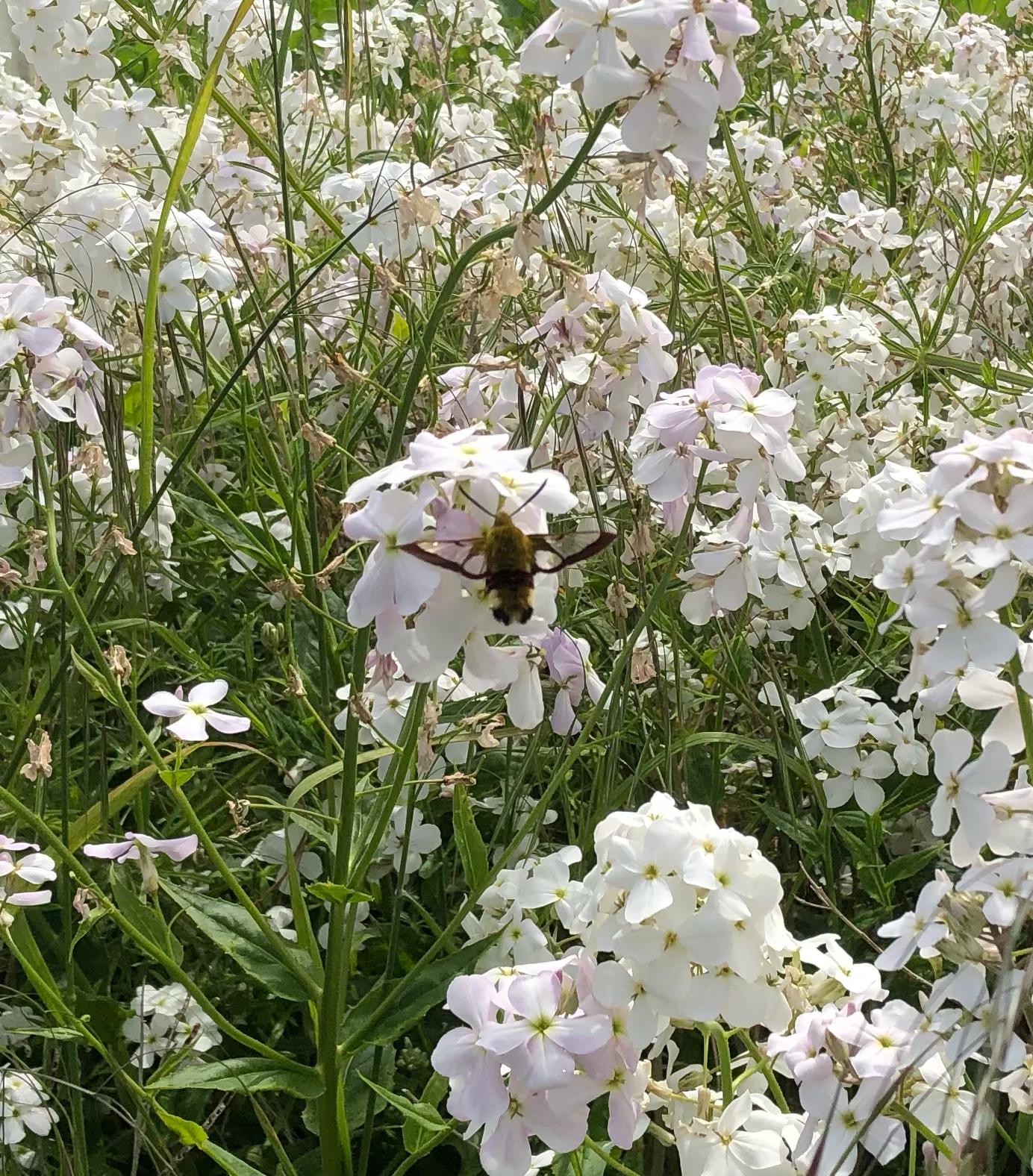
Good diurnal moths also began to put in appearances for Tim, who had this Broad-bordered Bee Hawkmoth on his allotment on the 7th.


Also on the 7th visiting birders found a dark Great Skua on the beach. There was some debate about its plumage and size, and hence identity, but since none of the resident birders saw it we are unable to comment 😁.  On the same day another (or perhaps the same) Rose-coloured Starling was seen in the South Dunes. Sean was yet again away from the village and beginning to despair, but this time there was a happy ending for him!


Here are a couple of nicer record shots of the bird from Patrick.


The starling was still in the valley the next day and Tim wheeled his big gun out for this portrait. 

Meanwhile after a very poor showing last year our little patch of parish Bee Orchids was performing very well with lots and lots of flower heads.  Here's one Mick photographed. 


With the improved weather in the second week of June some attention turned to dragonflies, and quite a lot of Red-veined Darters were observed in the north dunes, along with the more usual commoner species, and also a Norfolk Hawker. 


The North Dunes pools held a lot of life during this period, and it was very pleasurable just to sit by them and see what popped up.


The Lepidoptera action continued too, and Ted attracted this impressive herd of Small Elephants to his trap overnight on the 11th/12th. 


After a few days' absence the (or a) Rose-coloured Starling reappeared in the North Dunes on the 12th, found by another regular visitor, Stuart W, and was eventually tracked down to the coastwatch/carpark/huts area, where we were able to follow the stage directions! 


The Starling's reappearance was potentially very good news for Colin who was on his way back from a poorly-timed holiday in the Yorkshire Dales. Tragically for him he got stuck in a four hour traffic jam and although he looked hard for it when he finally got home, it had once again done a bunk.  It did reappear in the South Dunes very early the next day for Barry, but sadly not for Colin. 

So were there one, two, or three different individual Rosy Starlings?  It seems to us that at least two different birds were involved in the sightings between the 3rd and the 13th, but we haven't studied all the photos properly so if anyone has any opinions on this please let us know!

On the 14th Sean saw yet another potentially exciting Acro in the South Dunes which duly turned into yet another Reed Warbler. Also around this time Tiger Craneflies were becoming quite evident in the valley, although focusing a camera on these impressive little beasts instead of on the leaves behind them proved to be a tough challenge!


Last Autumn Sean had sowed a patch of his back garden with meadow wildflower and cornfield annual seeds, and the kinder weather of June meant that it was finally starting to bloom. 


 One of the pleasure of this was the variety of Hoverflies it was now attracting.  


On the 16th a male Bullfinch in the North Dunes was an unexpected find for Sean, but it wouldn't sit nicely for its picture!


In a major coup for his yearlist, Maynard returned from holiday in Scotland on the 17th, had a cycle round the concrete track, and put up a Bittern from one of the dykes!  

On the 20th large numbers of Swifts and hirundines were feeding over the fields to the west of the village, probably because cold northeasterly airstreams (again!) had pushed insects inland. This time last year saw the start of a really phenomenal movement of non-breeding Swifts down the coast, but no such movement happened this June.  On the 21st a Cuckoo was calling on farmland to the west too. 

The 22nd was a red letter day for two Collective members! Just after 3pm Sean was in his garden admiring hoverflies on his mini-meadow, and Pete was walking back from the allotments and had just reached the east end of Low Road, when they both heard unusual whiffling chittery calls coming from the north-west.  Both had been hoping for Bee-eaters and this was the first thought of both, but the sound wasn't right, it was more tern-like or wader-like. Suddenly the birds appeared, elegant, long-winged waders, chattering excitedly.  It was 3 Black-tailed Godwits, a full-on patch tick for Sean and a parish tick for Pete (who had seen two from the concrete track - on the patch but not in the parish - in February). 

Tim's allotment continued to repay his flower-planting strategy and produced a Hummingbird Hawkmoth on the 23rd - they have been scarce so far this year.


The weather towards the end of the month slipped back to being intermittently colder again, and for various individual reasons the Collective members did not get out in the field as much as usual. Despite this, Curlews started to be seen with some regularity, and Pat kept us updated with sightings from his house of the Peregrine which remained around the Church off and on throughout the month. 

The Little Terns finally started settling, with around 400 birds on the beach and good numbers of nests, but still having to endure a lot of cold and rainy weather. On the 27th Mick found a Black Tern on the beach too!


So as we go into July it's fingers crossed all round that the Little Terns can still have a successful breeding season despite the awful Spring, and we all applaud the efforts of Lottie, Will and the rest of the tern wardens and volunteers in helping these beautiful and rare birds which choose to spend their summer on our beach before winging their way back to Africa. What a privilege for us!

At the end of June the total number of bird species we have seen on the patch this year has reached 178, and Pat and Maynard are neck and neck in the race!  But of course, we are a collective, and we don't compete with each other at all. Honestly...

See you next month and happy patch birding everyone!

Sunday, 6 June 2021

May 2021 Roundup

With one or two fabulous exceptions, May turned out to be in large part a pretty miserable and cold continuation of April's conditions. Nevertheless there were a few bird spotting highs... 

On the 1st several Reed and Sedge Warblers were singing along the Holmes Road, and two Grasshopper Warblers were also reeling on the patch. A Short-eared Owl was seen over the village, and 19 Whimbrel were still present in the farmland at the north end. The evening saw a small fall of Wheatears in the North Dunes - Colin counted 9. 


Little Terns had also arrived, with an estimate of around 500 on the 2nd. Also on this date Mick had a high flying Black-tailed Godwit going south - the second record of this rare bird for here this year. 

Tern passage continued on the 3rd with Maynard noting Common, Arctic and Little moving north, as well as a Ring Ouzel in the South Dunes. On the same day we had a really big passage of Hirundines - all mostly going south, as they usually do in spring here! Pat saw a Short-eared Owl and 3 Yellow Wagtails in the North Dunes that morning too, and Sean had a flyover Canada Goose in the valley.  

Just before mid-day news came out that a Pallid Harrier had been seen up the coast at Waxham, and it was heading south. In the vague hope it might get to us, Sean headed into the North Dunes and sat on a hill, and Pat and Tim stationed themselves inland at the end of Low Road, as we have noticed that many southbound raptors seem to cut inland when they reach what we call 'the Warren' (a patch of rather open scrubby land west of the fence-line about half a mile north of the village).  An hour's skywatching produced 4 Red Kites and a host of Buzzards to entertain us, but there was no sign of the Harrier, so Pat and Tim went home and Sean got to his feet and started to wander slowly further north through the dunes.  We assumed the Harrier had either taken another route or whizzed through very quickly before we could get ourselves into position. However, amazingly, just before 1pm, over an hour after it was first reported, the Pallid Harrier appeared, sailing casually and elegantly across the dunes, riding the wind with effortless ease, and even deciding to take a detour east to dance over Sean's head before heading back inland and drifting casually into the Warren, just has we had predicted it might!  Sean immediately sent a photo via WhatsApp to our local group, and within about ten seconds Pat had called for further information.  "Get back to Low Road, it's flying really casually and dawdling, and it's heading through the Warren" Sean shouted down the phone, so Pat whizzed back and amazingly also saw it as it glided across the farmland.  It then headed on, on a more inland route, and was seen once more, further to the south of us. Incredibly, later analysis of the photos showed it was the same bird that had been on Bryher, in the Isles of Scilly, just a few days before!  It was a very special encounter with a really wonderful bird, and we must thank Will Walmsley and Robert Smith for putting the news out so promptly. 

Some of Sean's Pallid pics:


And here is an atmospheric pic taken by Pat as it crossed farmland on the west side of the village:


Back down to earth on the 4th a Swift appeared in the valley in the rain that morning, and very annoyingly a Bearded Tit flew over, pinging away, but Sean was unable to actually see it because of raindrops on his binoculars and glasses!  

On the morning of the 5th there were 2 Ring Ouzels in the valley, whilst the Iceland Gull was still here, on the south beach along with a summer plumaged Dunlin and a large party of Ringed Plovers. The Peregrine was seen on the east side of the church tower, and remained with us throughout the month again. 


On the 6th Sean attempted the first Breeding Birds Survey visit for the square which covers the first km of the North Dunes, and almost got frostbite trying to fill in the paperwork. A Cuckoo calling was the highlight of the visit. Later in the valley Mick had 4 Ring Ouzels and a cracking male Redstart which stayed for the next few days, proving to be a master of the vanishing act for the majority of the time it was here, although eventually most of us managed to see it. 

Now you see me...

...and now I'm gone!

On the 7th Mick S, one of our very regular visitors, had 2 Spoonbills flying south, but annoyingly none of us managed to get on to them.  They are a difficult year tick here! 


Meanwhile Lesser Whitethroats, Cuckoos and Ring Ouzels were still in evidence, with at least 5 Ouzels in the valley that morning, and Maynard had a Hobby in the North Dunes. Sean had a calling flyover Woodlark in the valley too, the first of the year.

On the 8th Maynard was lucky enough to see 4 Black Terns come in off, and Sean had Hobby and the Redstart in the valley, and the first significant arrival of local Swifts happened that evening, with quite a few flying around over the village. 

On the 9th there were two Spotted Flycatchers and a Whinchat in the valley, and a steady passage of Yellow Wagtails moving south with Pat counting 19 from the Plantation and Sean 6 in the valley. Up at the north end the Whimbrel were still present, with Tim counting 30, and also seeing two Woodlarks going south.  

On the 10th Spotted Flycatcher and Ring Ouzel remained for us locals, but once again we all managed to miss the best bird, a female Red-footed Falcon which Mick S saw as it whizzed south along the dune tops at the Plantation.  We really must try harder! Mick's photos below. 

On the 11th Tim had a Garden Warbler back at its usual territory and the rest of us caught up with it over the next few days. 


In an indication of how cold it continued to be, there were still a few Purple Sandpipers around at this point in the month too, and Tim took this fine picture on the 13th.


On the 16th there was a Common Sandpiper on the north beach amongst the groynes, and Tim and Mick were lucky enough to see a Turtle Dove whizzing south at speed from the Plantation. 

On the 18th Sean saw a Black Redstart and a late Redwing in the South Dunes.

On the 19th Sean had a tussle with this plain Acro in the valley which was resolutely silent and mostly refused to give itself up, although eventually he did get a couple of shots.  A tentative identification was concluded on the balance of probabilities, but readers' comments are always welcome! 


On the 20th Barry had another Common Sandpiper and later Tim and Mick had 2.  There was also a Red-breasted Merganser on the sea. Mick had 2 Canada Geese on the sea too! Sean's nocmig recorder picked up a Little Grebe over the house at 1.21am the previous night. That evening Pat had an Arctic Skua during a short seawatch.  

The cold weather continued and a Spotted Flycatcher in the Totem Pole bushes on the 21st was a sad sight as it huddled out of the wind with not a single insect to be had for its breakfast. 

On the morning of 22nd the (or a) Peregrine was hunting in the valley, and the Red-breasted Merganser was flying up and down the south beach.  Lesser Whitethroats remained in the valley, hopefully breeding,  but they were not singing at all so were often difficult to track down. 


At least 2 more Spotted Flycatchers were present in the valley on the 23rd and another on the 24th.  On the morning of the 25th, as cold weather continued, Sean saw two Hobbies sitting on the beach. When dog walkers came past they only flew a short way and landed on the sand again.  This was surely rather worrying behaviour and we feared that the lack of insects was really having an impact on them. We have heard of Hobbies dying of starvation in the UK this year...


On the 26th Mick had 2 Knot on the sand bar and 2 Arctic Terns flying north. On his way back from the seawatch he found another Spotted Flycatcher in the dunes near the houses off North Market Road. 

As the month ended breeding seemed to be getting underway for most species and several more Red Kites were seen, and as the weather finally began to show some incipient signs of warmth, butterflies and dragonflies at last began to emerge. It turned out to be a great month for both Green Haistreak and Brown Argus, and on top of those quite a few Walls, Painted Ladies and other moer common butterfly species were seen.  

On the 29th Pat had 3 Avocets and a Green Woodpecker from the Plantation, plus a Woodlark south, and Sean caught up with the Avocets a couple of days later.

 Fittingly for this month, it ended with another great bird being found by another visiting birder. This time it was Drew's turn to find this beautiful female Red-backed Shrike in the classic 'shrike bushes' north of the concrete blocks.  It was a tricky bird to see, but eventually we all managed. A male was also present a short way up the coast at Waxham, and we would have our own male a few days later, but that's the story of another month (where Drew will also play his part!).  Here are his own photos of his excellent bird. 


And one from Tim:


And what of Mays of yore? I hear you say... Here's three of Peter's accounts from last century to finish off with.  

Good patch birding everyone!

1989


1991 

1994